Most homeowners searching for a 12x25x4 filter are already ahead of the curve — they just don't know why yet.
After manufacturing air filters for over a decade and working directly with millions of homeowners, we've learned something the big-box stores won't tell you: filter depth matters more than most people realize. A 4-inch media bed isn't just a thicker filter — it's a fundamentally different level of protection. We've tested this repeatedly across modern high-efficiency furnaces and found that the expanded surface area captures significantly more particulates while actually reducing strain on the system, not adding to it.
The 12x25x4 hits a performance sweet spot we see validated every day through real customer feedback: longer filter life, fewer change-outs, and furnaces that run cleaner and quieter. This page breaks down exactly why that is — and how to confirm it's the right fit for your system.
TL;DR Quick Answers
What Are 12x25x4 Air Filters?
A 12x25x4 air filter is a 4-inch deep residential HVAC filter measuring 12 inches tall by 25 inches wide. It is designed for dedicated media cabinet slots found in modern high-efficiency furnaces.
Key facts:
Size: 12" H x 25" W x 4" D
Filter type: Pleated media filter
Available MERV ratings: MERV 8, MERV 11, MERV 13
Replacement interval: Every 6 to 12 months
Primary benefit: Greater surface area and longer filter life than standard 1-inch filters
Best for: High-efficiency furnaces with dedicated 4-inch media cabinet housings
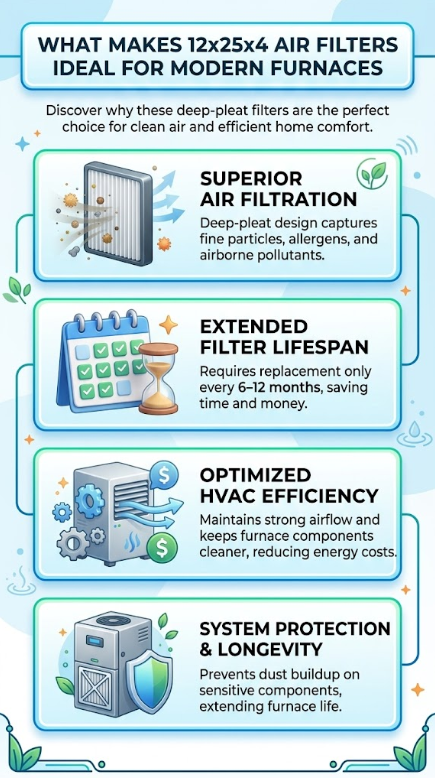
The 4-inch depth is what separates this filter from standard 1-inch options. It captures more particles, lasts longer, and supports higher MERV ratings — without restricting the airflow your modern furnace was engineered to breathe.
Top Takeaways
Depth matters as much as MERV rating. A 4-inch media means more surface area, more contact time, less airflow resistance. It's the factor most homeowners never consider — and the one that changes everything.
Modern furnaces were built for 4-inch filters. Media cabinet slots are a manufacturer specification. An undersized filter creates bypass airflow and system strain from the moment it's installed.
The right filter fit is an energy decision, not just an air quality one. The U.S. Department of Energy estimates proper filtration can cut HVAC energy consumption by up to 15%. That savings starts at installation — not months later.
Your indoor air is more polluted than you think. The EPA reports indoor pollutant levels are often 2 to 5 times higher than outdoors. A properly fitted 12x25x4 intercepts what's invisibly recirculating through your home every day.
MERV 13 performance requires the right depth to work safely. ASHRAE confirms MERV 13 captures at least 85% of harmful particles. In a 4-inch format, you get that protection. In a 1-inch format, you get the pressure drop that shortens equipment life and raises energy costs instead.
The Problem With Thin Filters in High-Efficiency Furnaces
Modern furnaces are engineered tighter than ever. Variable-speed blowers, multi-stage heating, and sealed combustion chambers all demand consistent, unrestricted airflow to perform correctly. What most homeowners don't realize is that a standard 1-inch filter creates a pressure drop that works directly against that engineering.
We see this play out repeatedly in service calls — a furnace short-cycling, running longer than it should, or struggling to reach a set temperature. In many cases, the filter isn't dirty. It's just the wrong depth for the system it's protecting.
The 12x25x4's 4-inch media bed resolves this by spreading the filtration load across dramatically more surface area. Less resistance. More airflow. A furnace that runs the way it was designed to run.
What the 4-Inch Depth Actually Does for Filtration
Filter depth isn't just about size — it's about contact time. Air moving through a 4-inch media bed spends more time in contact with the filter material than it does passing through a 1-inch filter at the same airflow rate.
That extended contact time is what makes the difference for capturing smaller particles — fine dust, pet dander, mold spores, and seasonal pollen. A deeper filter with the right MERV rating catches what thinner filters consistently miss, without needing to be replaced every 30 days.
In our experience, homeowners who switch to a 12x25x4 from a 1-inch filter in the same slot typically extend their replacement interval from one month to six to twelve months — with measurably cleaner air in between.
Why Modern Furnaces Are Specifically Built for 4-Inch Filters
Furnace manufacturers haven't been quiet about this. Many high-efficiency models produced in the last ten to fifteen years are built with a media cabinet slot — a dedicated housing designed specifically for 4-inch or 5-inch media filters. That slot isn't optional. Filling it with a 1-inch filter and a cardboard spacer isn't a workaround — it's a performance compromise.
The 12x25x4 is one of the most common sizes for these cabinets. When installed correctly, it seals the filter slot completely, eliminating bypass — the gap around undersized filters where unfiltered air sneaks through untouched.
The bypass is invisible, but the effects aren't. Dust buildup on heat exchangers and coils, shortened equipment life, and degraded indoor air quality are all common consequences we trace back to poor filter-to-cabinet fit.
MERV Rating Options and What Makes Sense for Most Homes
Not all 12x25x4 filters perform equally. The MERV rating determines what the filter actually captures:
MERV 8 handles common household dust, pollen, and lint — a solid baseline for most homes.
MERV 11 adds finer particle capture, including pet dander and mold spores — the right fit for homes with pets or mild allergy concerns.
MERV 13 captures bacteria, fine smoke particles, and virus-carrying droplets — the right choice for anyone managing respiratory conditions or immunocompromised household members.
One important note from real-world use: MERV 13 in a 4-inch format is far more forgiving on your system than MERV 13 in a 1-inch format. The added depth compensates for the denser media, keeping airflow resistance at a manageable level.
How to Confirm the 12x25x4 Is the Right Filter for Your System
Before ordering, confirm two things. First, measure your existing filter slot — not the old filter, the actual cabinet opening. Filters are labeled by nominal size, which can differ slightly from exact dimensions. Second, check your furnace manual or the inside of the furnace door for the manufacturer's recommended filter specification. Many high-efficiency systems list an approved filter depth directly.
If your system has a dedicated media cabinet and the opening measures approximately 12 by 25 inches with 4 inches of depth, the 12x25x4 is your filter. If you're unsure, the safest move is to bring the old filter's label to your HVAC professional or contact us directly — we've helped thousands of homeowners confirm the right fit before they buy.
"In over a decade of manufacturing air filters and working directly with homeowners, the single most common performance mistake we see isn't the wrong MERV rating — it's the wrong filter depth. A 12x25x4 doesn't just fit your modern furnace better; it works with the way your system was actually engineered to breathe."
7 Resources Every Homeowner Should Read Before Buying a 12x25x4 Air Filter
Don't take your indoor air for granted — and don't guess when it comes to protecting your furnace. We've pulled together the most useful resources out there so you can make a confident, informed decision. These are the references our own team reaches for when questions come up.
1. What the EPA Wants You to Know About MERV Ratings
Most homeowners have never heard of a MERV rating until they're standing in the filter aisle feeling completely lost. The U.S. EPA breaks it down clearly and without the jargon — this is the foundation every informed filter decision should be built on.
URL: https://www.epa.gov/indoor-air-quality-iaq/what-merv-rating
2. The EPA's Official Guidance on Protecting Your Family Through Better Filtration
Your family breathes what your filter misses. This EPA resource cuts straight to the point of choosing a filter that genuinely protects the people inside your home — not just the equipment around them.
3. How a Clean Filter Puts Money Back in Your Pocket
Here's something most people don't realize: the right filter doesn't just clean your air — it keeps your energy bills in check. ENERGY STAR's guidance shows exactly how filter maintenance connects to real savings, with the U.S. Department of Energy backing up every number.
URL: https://www.energystar.gov/saveathome/heating-cooling
4. FilterBuy's Straight-Talk Guide to Choosing the Right MERV Rating
After manufacturing filters for over a decade and working with millions of homeowners, we've learned that MERV selection isn't one-size-fits-all. This guide walks you through exactly what rating fits your home — pets, allergies, energy concerns and all — without the guesswork.
URL: https://filterbuy.com/resources/air-filter-basics/which-merv-rating-should-I-use/
5. What Happens to Your Furnace When You Choose the Wrong Filter
This is the resource we wish every homeowner would read before they buy. Built from real manufacturing data and direct customer experience, it reveals how a mismatched MERV rating quietly drives up your energy costs and shortens your system's life — before you ever notice a problem.
6. The Science-Backed Case for Why Filter Depth Changes Everything
We've said it before and the research backs it up: a 4-inch filter isn't just a bigger 1-inch filter — it's a fundamentally different level of protection. The Center for Energy and Environment explains exactly why, and when you should bring in an HVAC professional to retrofit your system for deeper media.
URL: https://www.mncee.org/furnace-filters-and-health
7. How to Avoid the Filter Sizing Mistakes That Hurt Your System
Bypass airflow is one of those invisible problems we see cause real damage — and it almost always starts with the wrong filter size. HVAC.com's buyer's guide gives you a clear, practical walkthrough for reading filter specs and confirming compatibility before you commit to a purchase.
URL: https://www.hvac.com/expert-advice/furnace-filters-101/
The Numbers Behind Why Your Filter Choice Matters More Than You Think
The data makes a compelling case for getting this decision right. Here are three statistics every homeowner researching a 12x25x4 air filter should know.
The air inside your home is likely more polluted than the air outside.
The U.S. EPA reports indoor pollutant concentrations are often 2 to 5 times higher than outdoor levels. Americans spend roughly 90% of their time breathing that air.
Here's what that looks like in practice. After over a decade of manufacturing filters, we consistently find that homeowners most surprised by this number share one thing in common:
They're running undersized or wrong-depth filters
Invisible pollutants — pet dander, mold spores, fine particulates — keep recirculating uninterrupted
Their filter simply can't keep pace with what the EPA's own data describes
A 12x25x4's expanded media surface is built for exactly that load. Thin filters in high-demand systems never were.
Source: U.S. EPA — Indoor Air Quality
URL: https://www.epa.gov/report-environment/indoor-air-quality
A mismatched filter doesn't just hurt your air quality — it raises your energy bill.
The U.S. Department of Energy estimates a clean, properly fitted air filter can cut HVAC energy consumption by up to 15%. What that number doesn't capture is where the waste actually begins.
In our experience, it starts at installation — not when the filter gets dirty. Here's the pattern we see repeatedly:
Homeowner installs the wrong filter depth
The system strains against restricted airflow from day one
Energy costs climb before the filter even needs replacing
The homeowner blames the furnace — not the filter
When those same customers switch to a correctly fitted 12x25x4, the results are immediate. Shorter run cycles. Faster temperature recovery. Lower utility bills. Proper filter fit is where the savings begin — not filter cleanliness alone.
Source: ENERGY STAR / U.S. Department of Energy — Heat and Cool Efficiently
URL: https://www.energystar.gov/saveathome/heating-cooling
At the right MERV rating, a 4-inch filter captures the particles that threaten your family's health.
ASHRAE's Epidemic Task Force establishes that MERV 13 filters capture at least 85% of particles in the 1 to 3 micron range. That includes:
Bacteria
Fine mold spores
Virus-carrying respiratory droplets
Here's what ASHRAE's data points to — and what years of product development and direct customer feedback have confirmed for us. Achieving MERV 13 performance without harming your system depends entirely on filter depth.
A MERV 13 filter in a 1-inch format creates airflow resistance most furnaces can't handle
That same rating in a 12x25x4 format spreads the load across a 4-inch media bed
The result: 85%-plus particle capture without the pressure drop that shortens blower motor life
Depth isn't a bonus feature on a high-MERV filter. It's what makes the rating achievable in a real home.
Source: ASHRAE Epidemic Task Force — Filtration and Disinfection Guidance
Our Final Thought on 12x25x4 Air Filters and Modern Furnaces
After over a decade of manufacturing filters and working with millions of homeowners, here's the opinion we keep coming back to:
The HVAC industry has dramatically undereducated homeowners on filter depth — and that gap is costing families real money, real equipment life, and real air quality every day.
The Conversation Has Been Incomplete
Most air filtration discussions focus on MERV ratings. That's not wrong — but it's only half the equation. Rating without depth is an incomplete answer.
Here's what we've seen happen repeatedly:
Homeowner upgrades to MERV 13 in a 1-inch format
Energy bills climb. Temperatures become uneven. Equipment strains
The filter did exactly what it was rated to do
The system simply couldn't breathe through it
That's the insight the industry consistently misses. It's also why we consider the 12x25x4 one of the most underappreciated upgrades available to a modern homeowner.
What This Page Comes Down To
Here's our honest summary — four things we believe every homeowner should walk away knowing:
Filter depth changes the performance equation entirely. A 4-inch media bed delivers more contact time, more surface area, and less airflow resistance than any 1-inch filter can match at the same MERV rating.
Modern furnaces were engineered for this. Dedicated media cabinet slots aren't optional features. They're the manufacturer telling you exactly what the system was designed to use.
The efficiency gains are immediate. Proper filter fit reduces system strain from the moment of installation — not just when the filter gets dirty.
Science all points the same direction. The EPA, ENERGY STAR, and ASHRAE agree — indoor air is more polluted than most people realize, and achieving high MERV performance without harming your system requires the right filter depth.
Our Honest Opinion
If your system has a media cabinet slot designed for a 12x25x4 and you're filling it with anything thinner — you're leaving both air quality and system efficiency on the table.
Little effort. Big impact. That's what a properly fitted 12x25x4 delivers every time.
You're the hero of your household when it comes to protecting your family's air. This is one of the simplest, highest-impact decisions you can make to do exactly that.
FAQ on 12x25x4 Air Filters
Q: What does 12x25x4 mean on an air filter?
A: The three numbers are the filter's dimensions.
12 = height in inches
25 = width in inches
4 = depth in inches
The 4-inch depth is the critical number. It delivers:
More surface area than a 1-inch filter
Longer service life between replacements
Higher MERV ratings without restricting furnace airflow
Always measure your actual filter slot before ordering. Nominal sizes can differ slightly from exact dimensions.
Q: How do I know if a 12x25x4 air filter fits my furnace?
A: Check these three things before ordering:
Look at your existing filter. The size is printed on the cardboard frame
Measure your filter cabinet opening. Measure the slot — not the old filter
Check your furnace manual. Many high-efficiency furnaces list the approved filter depth on the inside of the furnace door
Key indicator: if your system has a dedicated media cabinet housing attached to the furnace, it was almost certainly designed for a 4-inch filter. The 12x25x4 is one of the most common sizes for those cabinets.
Q: How often should I replace a 12x25x4 air filter?
A: Most homeowners replace a 12x25x4 every 6 to 12 months. That's significantly longer than the 30-day cycle of standard 1-inch filters.
Replacement intervals vary based on:
Pets — dander loads filters faster
Allergies or respiratory conditions — more frequent changes improve air quality
Local air quality — high dust or pollen environments shorten filter life
System run time — year-round operation accelerates filter loading
Pro tip: Check your filter visually every 3 months. When the media looks visibly gray and loaded — replace it, regardless of the calendar.
Q: What MERV rating should I choose for my 12x25x4 air filter?
A: Match the MERV rating to your household's specific needs:
MERV 8 — Captures dust, pollen, and lint. Right for standard households with no significant health concerns
MERV 11 — Adds pet dander and mold spore capture. Best for pet owners and mild allergy sufferers
MERV 13 — Captures bacteria, fine smoke particles, and virus-carrying droplets. Best for households with respiratory conditions or immunocompromised family members
Important: MERV 13 in a 4-inch format is far more system-friendly than MERV 13 in a 1-inch format. The added depth compensates for the denser media — delivering premium filtration without the airflow penalty.
Q: Can I use a 12x25x4 air filter if my furnace currently uses a 1-inch filter?
A: Not without a media cabinet retrofit. A 12x25x4 requires a dedicated 4-inch housing. You cannot insert a 4-inch filter into a 1-inch slot.
Here's why the upgrade is worth considering:
Media cabinet installations are straightforward for a qualified HVAC technician
It's a one-time investment with long-term returns
Benefits include extended filter life, better air quality, and reduced system strain
Many homeowners report immediate performance improvements after switching
Next step: consult a licensed HVAC professional to assess your system's compatibility before purchasing.
Find the Right 12x25x4 Air Filter for Your Modern Furnace Today
Your furnace was engineered for better filtration — make sure your filter lives up to it. Shop our American-made 12x25x4 air filters in MERV 8, MERV 11, and MERV 13 and get the right fit delivered directly from our factory to your door.
Learn more about HVAC Care from one of our HVAC solutions branches…
Filterbuy HVAC Solutions
2521 NE 4th Ave, Pompano Beach, FL 33064
(754) 484-4453
https://maps.app.goo.gl/JmWkEXya7uzuLzBh8